A Type of Art That Explores Shapes Colors and Themes Not Derived From the Visual World
xx Revolutionary Fine art Movements That Have Shaped Our Visual History
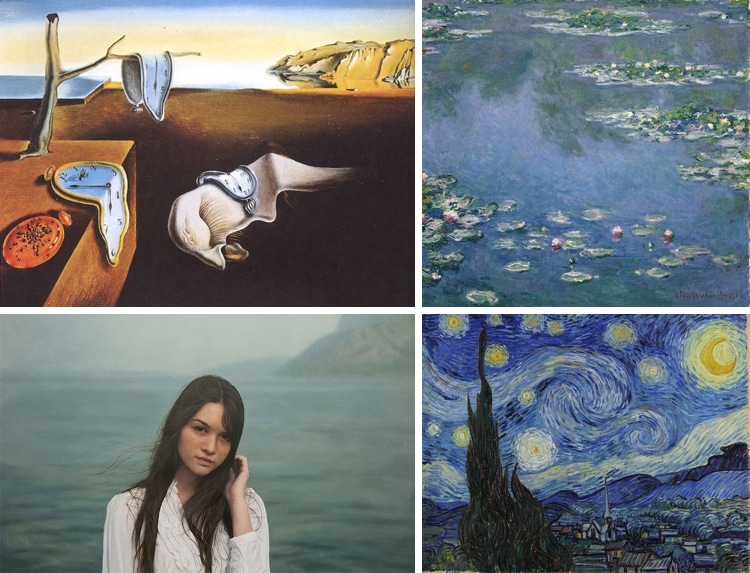
Looking dorsum through Western history, it'southward incredible to meet how many types of art have made an impact on society. Past tracing a timeline through dissimilar art movements, we're able to not only see how mod and contemporary art has adult, but besides how art is a reflection of its time.
For instance, did y'all know that Impressionism was once considered an clandestine, controversial movement or that Abstruse Expressionism signaled a shift in the art earth from Paris to New York? Similar building blocks, from Realism to Lowbrow, these different types of fine art are interconnected. Equally the artistic pendulum swings, artistic styles are often reactions against or homages to their predecessors. And by looking back at some of the about important fine art movements in history, we accept a clearer understanding of how famous artists like Van Gogh, Picasso, and Warhol have revolutionized the art world.
These twenty visual art movements are central to understanding the different types of art that shape modern history.
Italian Renaissance Fine art
From the 14th through 17 century, Italy underwent an unprecedented age of enlightenment. Known equally the Renaissance—a term derived from the Italian give-and-take Rinascimento, or "rebirth"—this menstruation saw increased attention to cultural subjects similar art and architecture.
Italian Renaissance artists similar Michelangelo, Leonardo da Vinci, and Raphael institute inspiration in classical art from Ancient Rome and Hellenic republic, adopting aboriginal interests like balance, naturalism, and perspective. In Renaissance-era Italy, this antiquity-inspired approach materialized as humanist portrait painting, anatomically correct sculpture, and harmonious, symmetrical architecture.
Artists to Know: Leonardo da Vinci, Michelangelo, Raphael, Titian
Iconic Artwork: Birth of Venus by Sandro Botticelli (1486), The Last Supper by Leonardo da Vinci (1495 – 1498),Mona Lisa (c. 1503 – 1506),David by Michelangelo (1501 – 1504), The School of Athens by Raphael (1509 – 1511)
Baroque
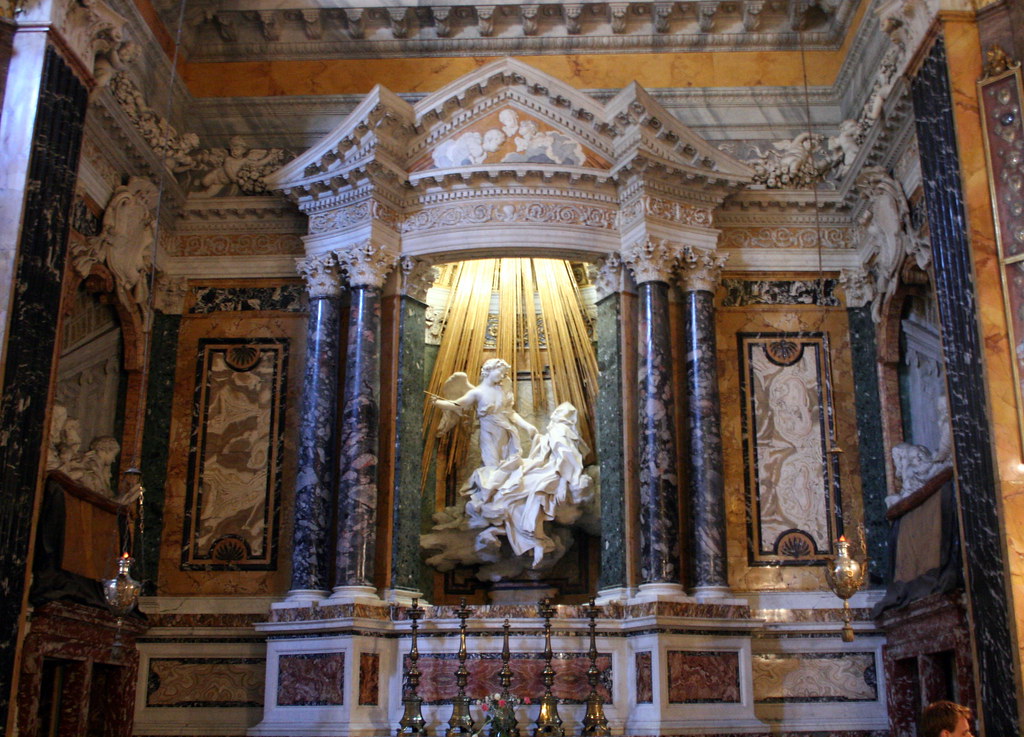
"The Ecstasy of St. Teresa" past Bernini. 1647-1652. Cornaro Chapel, Santa Maria della Vittoria, Rome
Toward the end of the Renaissance, the Baroque motion emerged in Italy. Like the preceding genre, Bizarre art showcased artistic interests in realism and rich color. Dissimilar Renaissance art and architecture, still, Baroque works too emphasized extravagance.
This opulence is evident in Baroque painting, sculpture, and architecture. Painters like Caravaggio suggested drama through their treatment of light and depiction of move. Sculptors like Bernini achieved a sense of theatricality through dynamic contours and intricate pall. And architects across Europe embellished their designs with decoration ranging from intricate carvings to imposing columns.
Artists to Know: Caravaggio, Rembrandt, Bernini
Iconic Artwork: The Calling of Saint Matthew by Caravaggio (1599 –1600),The Night Watch past Rembrandt (1642), The Ecstasy of St. Teresa past Bernini (1647 – 1652)
Rococo
Following the extravagance and ability of Bizarre fine art came the lighthearted and flirtatious Rococo motion, which blossomed in 18th-century France earlier spreading to other European countries. The termRococo derives fromrocaille, a method of decoration using pebbles, seashells, and cement to adorn grottoes and fountains in the Renaissance. During the 1730s, the rocaille decoration inspired scrolling curves in ornamental furniture and interior pattern. In painting, this decorative manner transferred to a love of whimsical narratives, pastel colors, and fluid forms.
Artists to know: Jean-Honoré Fragonard, Antoine Watteau, François Boucher
Iconic Artwork: The Swing by Jean-Honoré Fragonard (1767)
Neoclassicism
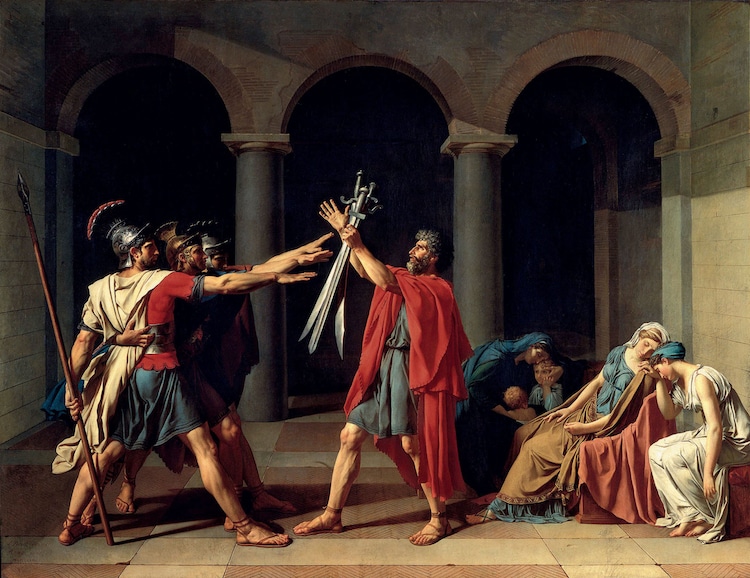
Jacques-Louis David, "The Oath of the Horatii," 1784–five (Photo: Wikimedia Commons, Public domain)
Neoclassicism is an 18th-century art motion based on the ideals of art from Rome and Ancient Greece. Its interest in simplicity and harmony was partially inspired every bit a negative reaction to the overly frivolous aesthetic of the decorative Rococo style. The discovery of Roman archaeological cities Pompeii and Herculaneum (in 1738 and 1748, respectively) helped galvanize the spirit of this movement.
Artists to Know: Jacques-Louis David, Jean-Auguste-Dominique Ingres, Antonio Canova
Iconic Artwork: The Oath o the Horatii by Jacques-Louis David (1784–1785),The Decease of Socrates past Jacques-Louis David (1787), Expiry of Marat by Jacques-Louis David (1793), The Grande Odalisque past Ingres (1814)
Romanticism
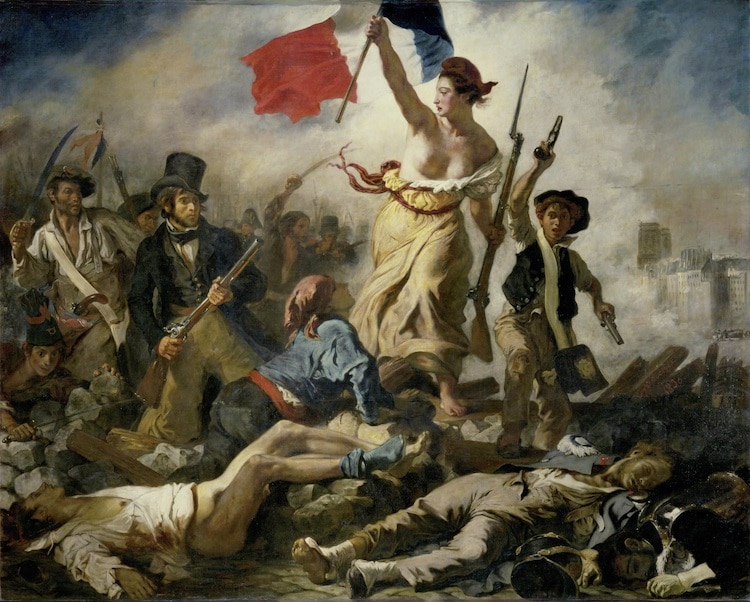
Eugène Delacroix, "Liberty Leading the People," 1830 (Photo: Wikimedia Commons, Public domain)
Romanticism was a cultural movement that emerged effectually 1780. Until its onset, Neoclassicism dominated 18th-century European art, typified by a focus on classical subject matter, an involvement in aesthetic austerity, and ideas in line with the Enlightenment, an intellectual, philosophical, and literary movement that placed emphasis on the individual.
Artists like Eugène Delacroixfound inspiration in their own imaginations. This introspective arroyo lent itself to an art grade that predominantly explored the spiritual.
Artists to Know: Joseph Mallord William Turner, Eugène Delacroix, Theodore Gericault, Francisco Goya
Iconic Artwork: Wanderer Above the Ocean of Fog by Caspar David Friedrich (1818), Freedom Leading the People by Delacroix (1830)
Realism
Realism is a genre of art that started in French republic later on the French Revolution of 1848. A clear rejection of Romanticism, the ascendant manner that had come up earlier information technology, Realist painters focused on scenes of contemporary people and daily life. What may seem normal now was revolutionary afterwards centuries of painters depicting exotic scenes from mythology and the Bible, or creating portraits of the nobility and clergy.
French artists like Gustave Courbet and Honoré Daumier, equally well every bit international artists like James Abbott McNeill Whistler, focused on all social classes in their artwork, giving phonation to poorer members of gild for the first time and depicting social issues stemming from the Industrial Revolution. Photography was as well an influence on this type of fine art, pushing painters to produce realistic representations in contest with this new technology.
Artists to Know: Gustave Courbet, Jean-Baptiste-Camille Corot, Jean-François Millet, James McNeill Whistler
Iconic Artwork:The Gleanerspast Jean-François Millet (1857), The Burial at Ornans by Gustave Courbet (1849 – 1850)
Impressionism
It may exist difficult to believe, but this now dearest art genre was one time an outcast visual movement. Breaking from Realism, Impressionist painters moved away from realistic representations to use visible brushstrokes, vivid colors with little mixing, and open up compositions to capture the emotion of light and movement. Impressionism started when a group of French artists broke with academic tradition past painting en plein air—a shocking determination when most landscape painters executed their work indoors in a studio.
The original grouping, which included Claude Monet, Pierre-Auguste Renoir, Alfred Sisley, and Frédéric Bazille, was formed in the early on 1860s in France. Additional artists would join in forming their own society to showroom their artwork after being rejected by the traditional French salons, who deemed it too controversial to exhibit. This initial underground exhibition, which took place in 1874, allowed them to gain public favor.
Artists to Know: Claude Monet, Camille Pissarro, Pierre-Auguste Renoir, Mary Cassatt
Iconic Artwork: Impression, Sunrise past Monet (1872), Bal du Moulin de la Galette by Renoir (1876), Water Liliesseries by Monet (1890s – 1900s)
Post-Impressionism
Again originating from France, this type of art developed between 1886 and 1905 every bit a response to the Impressionist move. This fourth dimension, artists reacted against the need for the naturalistic depictions of calorie-free and color in Impressionist fine art. Every bit opposed to before styles, Postal service-Impressionism covers many unlike types of fine art, from the Pointillism of Georges Seurat to the Symbolism of Paul Gauguin.
Not unified by a single style, artists were united by the inclusion of abstruse elements and symbolic content in their artwork. Perhaps the most well-known Post-Impressionist is Vincent van Gogh, who used colour and his brushstrokes not to convey the emotional qualities of the landscape, but his ain emotions and state of heed.
Artists to Know: Georges Seurat, Vincent van Gogh, Paul Cézanne, Paul Gauguin, Émile Bernard
Iconic Artwork: A Sunday Afternoon on La Grande Jatte by Georges Seurat (1884 – 1886), The Starry Nightby Vincent van Gogh (1889), The Yellow Christ past Paul Gauguin (1891)
Fine art Nouveau
At the end of the 19th century, a movement of "new art" swept through Europe. Characterized by an interest in stylistically reinterpreting the beauty of nature, artists from beyond the continent adopted and adapted this advanced style. Every bit a result, it materialized in sub-movements likethe Vienna Secession in Austria,Modernisme in Spain, and, most prominently,Art Nouveau in French republic.
The French Fine art Nouveau style was embraced by artists working in a range of mediums. In improver to the fine arts, like painting and sculpture, it featured heavily in architecture and decorative arts of the period. Still, perhaps its near enduring legacy can be found in the poster—a commercial arts and crafts that Czech artist Alphonse Mucha helped elevate as a modern fine art form.
Artists to Know: Alphonse Mucha, Gustav Klimt
Iconic Artwork: The Four Seasons by Alphonse Mucha, The Kiss by Gustav Klimt
Cubism
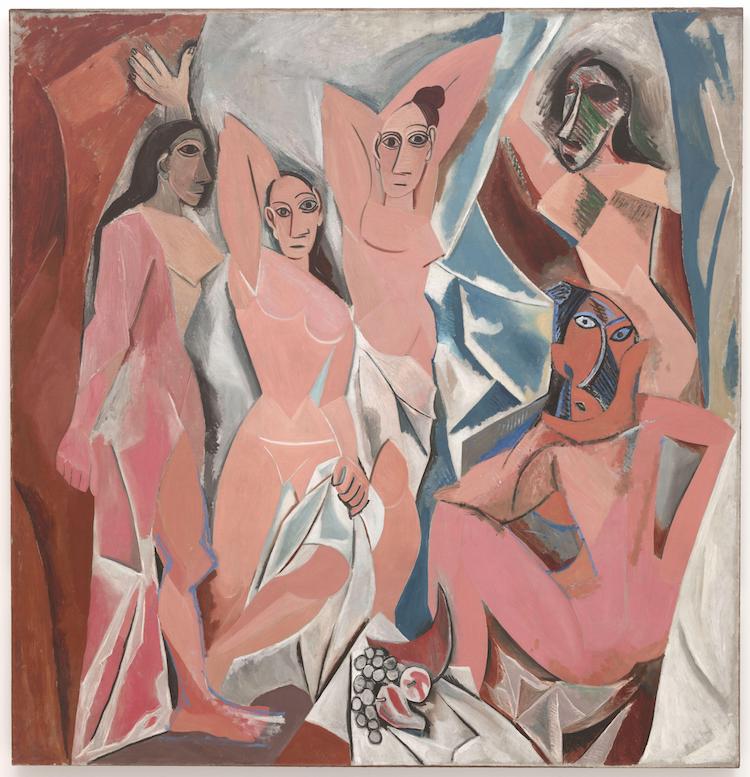
Pablo Picasso, "Les Demoiselles d'Avignon," 1907 (Photo: Wikimedia Commons, Fair Employ)
A truly revolutionary way of fine art, Cubism is ane of the most important art movements of the 20th century. Pablo Picasso and Georges Braque developed Cubism in the early 1900s, with the term being coined by art critic Louis Vauxcelles in 1907 to describe the artists. Throughout the 1910s and 1920s, the ii men—joined by other artists—would utilize geometric forms to build up the last representation. Completely breaking with any previous art move, objects were analyzed and cleaved apart, only to be reassembled into an bathetic form.
This reduction of images to minimal lines and shapes was part of the Cubist quest for simplification. The minimalist outlook as well trickled down into the colour palette, with Cubists forgoing shadowing and using limited hues for a flattened appearance. This was a articulate pause from the use of perspective, which has been the standard since the Renaissance. Cubism opened the doors for later fine art movements, like Surrealism and Abstract Expressionism, by throwing out the prescribed creative person'due south rulebook.
Artists to Know: Pablo Picasso, Georges Braque, Juan Gris
Iconic Artwork:Les Demoiselles d'Avignon by Pablo Picasso (1907)
Futurism
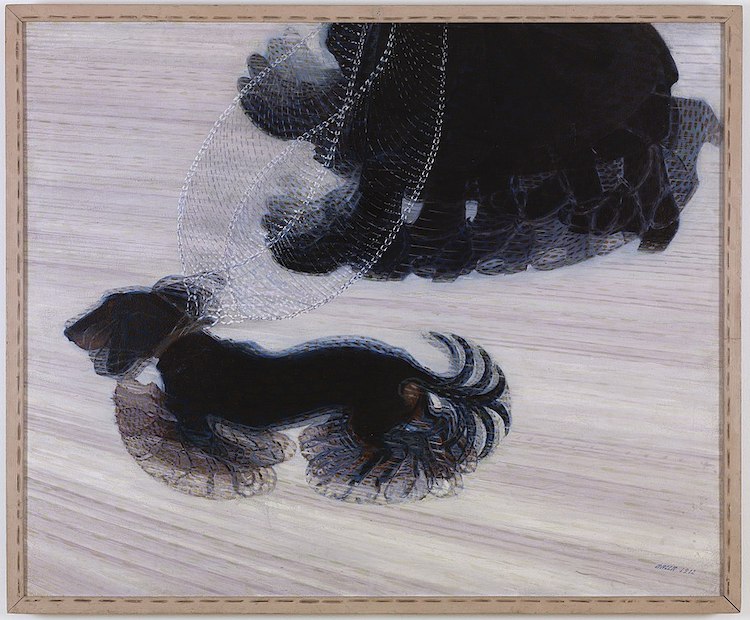
Giacomo Balla, "Dynamism of a Dog on a Leash," 1912 (Photo: Wikimedia Commons, Public domain)
Fascinated by new manufacture and thrilled by what lay ahead, the early 20th-centuryFuturists carved out a place in history. Growing out of Italy, these artists worked as painters, sculptors, graphic designers, musicians, architects, and industrial designers. Equally the early manifesto did non directly accost the artistic output of Futurism, it took some time earlier in that location was a cohesive visual. A hallmark of Futurist fine art is the depiction of speed and motility. In detail, they adhered to principles of "universal dynamism," which meant that no unmarried object is separate from its groundwork or some other object.
This is best exemplified in Giacomo Balla'sDynamism of a Domestic dog on a Ternion, where the motion of walking the dog is shown through the multiplying of the dog's feet, leash, and owner's legs.
Artists to Know: Giacomo Balla, Umberto Boccioni
Iconic Artwork: Dynamism of a Domestic dog on a Leash by Giacomo Balla (1912), Unique Forms of Continuity in Space by Umberto Boccioni (1913)
Dada
Dada was a 20th-century advanced art movement (ofttimes referred to equally an "anti-fine art" movement) born out of the tumultuous societal landscape and turmoil of WWI. Information technology began as a tearing reaction and revolt against the horrors of war and the hypocrisy and follies of bourgeois lodge that had led to it. In a subversion of all aspects of Western civilization (including its art), the ideals of Dada rejected all logic, reason, rationality, and order—all considered pillars of an evolved and advanced society since the days of the Enlightenment.
Artists to Know: Marcel Duchamp, Man Ray, Tristan Tzara
Iconic Artwork: Fountain by Marcel Duchamp (1917)
Bauhaus
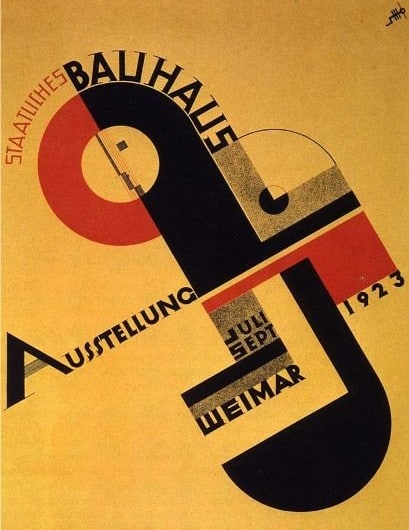
Poster for the Bauhaus movement by Joos Schmidt, 1923 (Photo: Wikimedia Commons, Public domain)
Ranging from paintings and graphics to architecture and interiors,Bauhaus fine art dominated many outlets of experimental European art throughout the 1920s and 1930s. Though information technology is most closely associated with Germany, it attracted and inspired artists of all backgrounds. Bauhaus—literally translated to "construction house"—originated every bit a German language school of the arts in the early 20th century. Founded by Walter Gropius, the school eventually morphed into its ain modern art movement characterized by its unique approach to architecture and pattern.
Artists to Know: Wassily Kandinsky, Paul Klee, Joost Schmidt, Marcel Breur
Iconic Artwork: Yellow-Scarlet-Blue by Wassily Kandinsky (1925), Wassily Chair by Marcel Breur (1925)
Art Deco

© 2019 Tamara Fine art Heritage / ADAGP, Paris / ARS, NY
Fine art Deco is a modernist movement that emerged in 1920s Europe. While many dissimilar aesthetics compose the movement—including different color palettes and a range of materials, from ebony and ivory to wood and plastic—it is virtually frequently characterized by streamlined, geometric forms assorted by rich ornamentation and linear decoration.
Paintings produced in the Art Deco manner typically feature bold forms and busy compositions. Some, like those by Polish-born painter Tamara de Lempicka, depict dynamic portraits of stylish subjects. Typically, these figures are dressed in vivid colors and prepare in abstracted metropolitan locations.
Artists to Know: Tamara de Lempicka
Iconic Artwork: Tamara in a Green Bugatti by Tamara de Lempicka (1929)
Surrealism
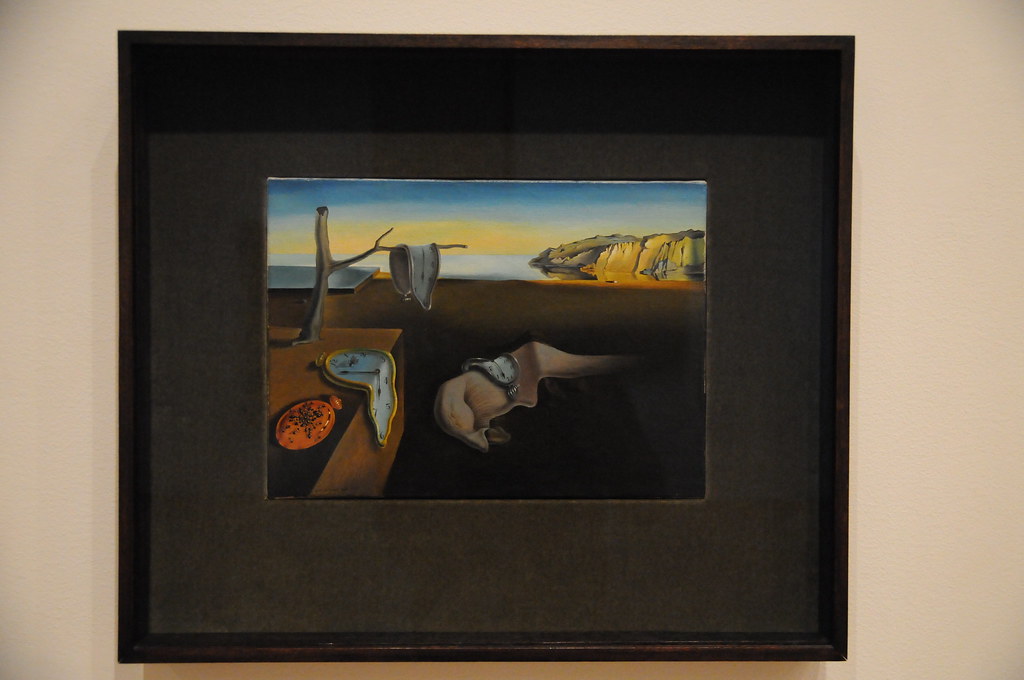
"The Persistence of Retentivity" by Salvador Dalí. 1931. MoMA, New York.
A precise definition of Surrealism can be difficult to grasp, only it's clear that this once avant-garde movement has staying power, remaining 1 of the most approachable art genres, even today. Imaginative imagery spurred past the subconscious is a hallmark of this type of art, which started in the 1920s. The movement began when a group of visual artists adopted automatism, a technique that relied on the subconscious for creativity.
Tapping into the entreatment for artists to liberate themselves from restriction and take on full creative freedom, Surrealists often challenged perceptions and reality in their artwork. Role of this came from the juxtaposition of a realistic painting style with unconventional, and unrealistic, subject matters.
Artists to Know: Salvador Dalí, Max Ernst, René Magritte
Iconic Artwork: The Treachery of Images by René Magritte (1929), The Persistence of Memoryby Salvador Dalí (1931)
Abstract Expressionism

"Autumn Rhythm (Number xxx)" past Jackson Pollock. 1950. Metropolitan Museum of Fine art, New York.
Abstract Expressionism is an American art movement—the first to explode on an international calibration—that started subsequently World War Ii. Information technology solidified New York as the new centre of the art world, which had traditionally been based in Paris. The genre adult in the 1940s and 1950s, though the term was also used to draw work by before artists like Wassily Kandinsky. This style of art takes the spontaneity of Surrealism and injects it with the dark mood of trauma that lingered post-War.
Jackson Pollock is a leader of the movement, with his drip paintings spotlighting the spontaneous creation and gestural paint application that defines the genre. The term "Abstract Expressionism," though closely married to Pollock'southward piece of work, isn't limited to ane specific style. Work every bit varied every bit Willem de Kooning'due south figurative paintings and Mark Rothko's colour fields are grouped under the umbrella of Abstruse Expressionism.
Artists to Know: Jackson Pollock, Willem de Kooning, Clyfford Still, Mark Rothko
Iconic Artwork:Autumn Rhythm (Number 30)by Jackson Pollock
Pop Art
Rising up in the 1950s, Pop Art is a pivotal movement that heralds the onset of gimmicky art. This mail-war style emerged in Britain and America, including imagery from advertizement, comic books, and everyday objects. Often satirical, Pop Art emphasized banal elements of mutual appurtenances and is frequently thought of as a reaction against the subconscious elements of Abstract Expressionism.
Roy Lichtenstein's bold, vibrant work is an excellent case of how parody and pop culture merged with fine art to make attainable fine art. Andy Warhol, the near famous of the Pop Art figures, helped push the revolutionary concept of art every bit mass production, creating numerous silkscreen serial of his popular works.
Artists to Know: Andy Warhol, Roy Lichtenstein, Jasper Johns
Iconic Artwork:Campbell'southward Soup Cans past Andy Warhol (1962)
Installation Art
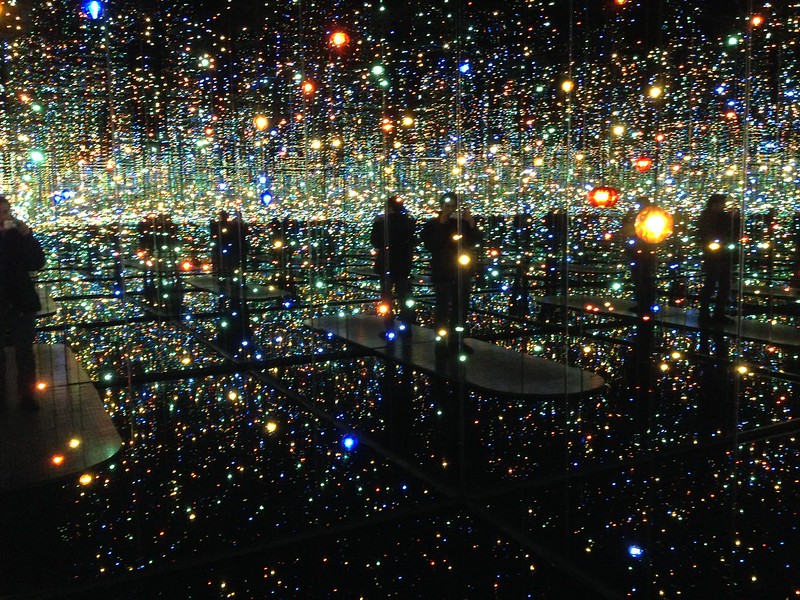
"The Souls of Millions of Light Years Away" by Yayoi Kusama
In the eye of the 20th century, advanced artists in America and Europe began producing Installation Fine art. Installations are 3-dimensional constructions that play with infinite to interactively appoint viewers. Often big-scale and site-specific, these works of art transform museums, galleries, and even outdoor locations into immersive environments.
Inspired by Marcel Duchamp'southward DadaistReadymades—a serial of found objects contextualized as sculptures— this important genre was pioneered by modern masters similar Yayoi Kusama and Louise Bourgeois. Today, contemporary artists keep his practise live, crafting experimental installations from mediums similar cord, paper, and flowers.
Artists to Know: Yayoi Kusama, Louise Bourgeois, Damien Hirst
Iconic Artwork:Mirror Rooms by Yayoi Kusama
Kinetic Art
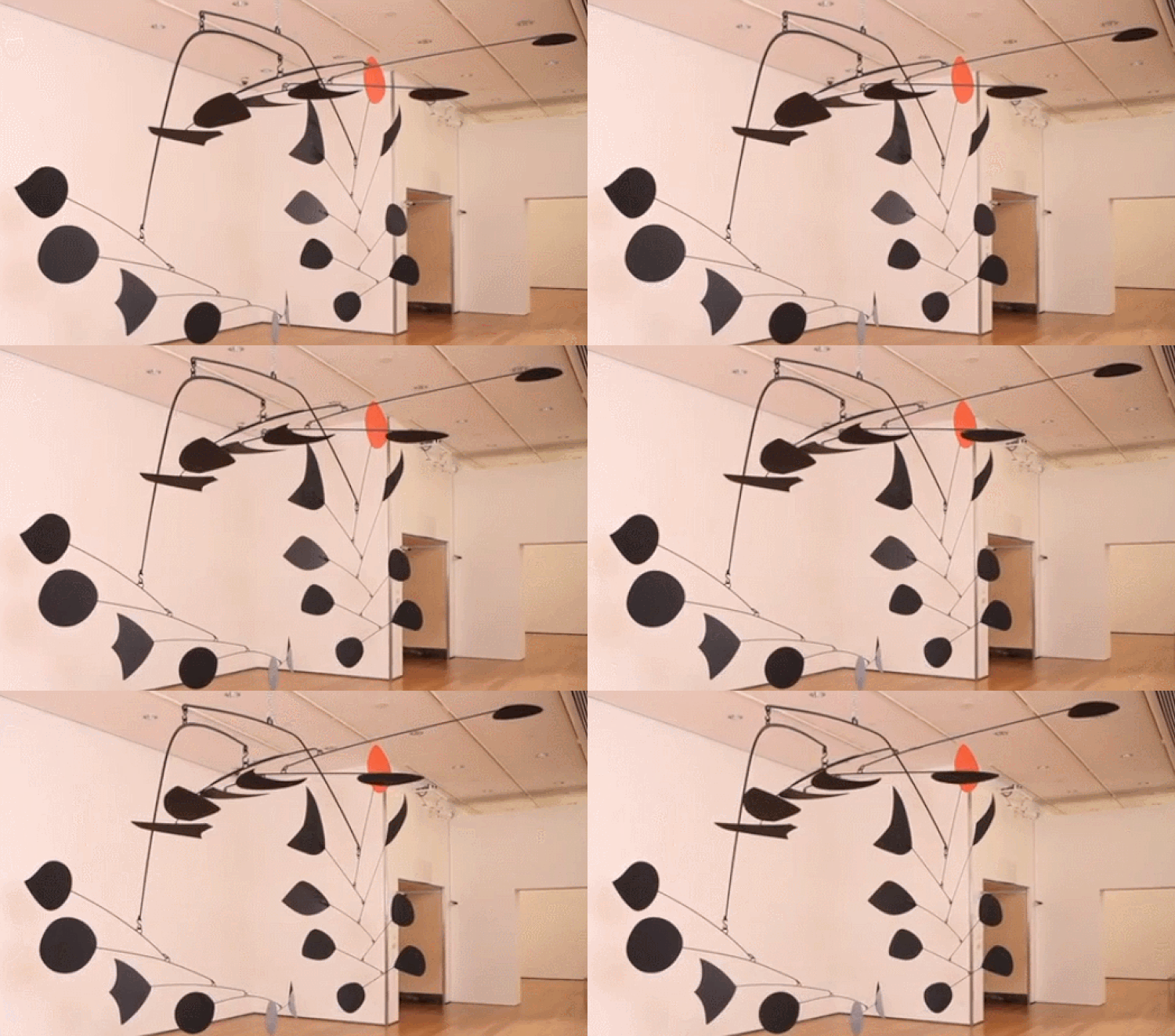
"Rouge Triomphant (Triumphant Red)" past Alexander Calder. 1959–1965.
The seemingly gimmicky art movement actually has its roots in Impressionism, when artists first began attempting to express movement in their art. In the early on 1900s, artists began to experiment further with art in motility, with sculptural machine and mobiles pushing kinetic art forrard. Russian artists Vladimir Tatlin and Alexander Rodchenko were the first creators of sculptural mobiles, something that would later be perfected by Alexander Calder.
In gimmicky terms, kinetic fine art encompasses sculptures and installations that have movement as their main consideration. American creative person Anthony Howe is a leading figure in the contemporary motion, using estimator-aided pattern for his large-scale air current-driven sculptures.
Artists to Know: Alexander Calder, Jean Tinguely, Anthony Howe
Iconic Artwork: Arc of Petalsby Alexander Calder
Photorealism
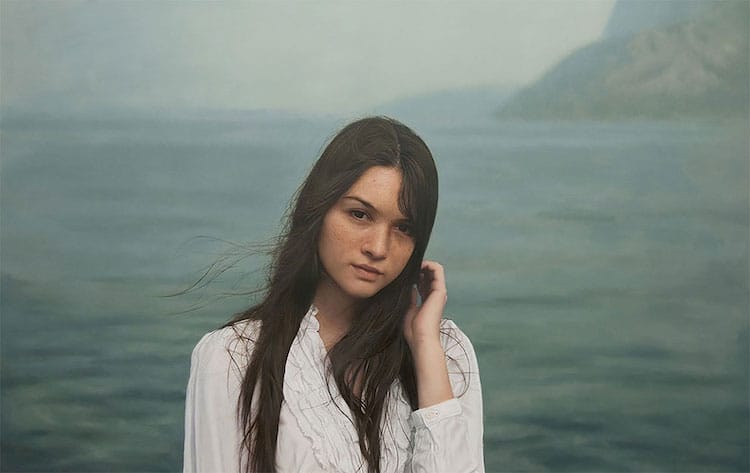
"Untitled" past Yigal Ozeri. 2012.
Photorealism is a style of art that is concerned with the technical power to wow viewers. Primarily an American art motility, information technology gained momentum in the belatedly 1960s and 1970s as a reaction against Abstruse Expressionism. Hither, artists were most concerned with replicating a photo to the best of their ability, carefully planning out their piece of work to slap-up issue and eschewing the spontaneity that is the hallmark of Abstract Expressionism. Like to Pop Fine art, Photorealism is often focused on imagery related to consumer culture.
Early Photorealism was steeped in nostalgia for the American landscape, while more recently, photorealistic portraits have become a more common bailiwick. Hyperrealism is an advocacy of the artistic style, where painting and sculpture are executed in a style to provoke a superior emotional response and to arrive at higher levels of realism due to technical developments. A common thread is that all works must showtime with a photographic reference point.
Artists to Know: Chuck Close, Ralph Going, Yigal Ozeri
Iconic Artwork: Untitledpast Yigal Ozeri
Lowbrow
Lowbrow, likewise chosen popular surrealism, is an fine art movement that grew out of an clandestine California scene in the 1970s. Traditionally excluded from the fine fine art world, lowbrow art moves from painted artworks to toys, digital fine art, and sculpture. The genre also has its roots in underground comix, punk music, and surf culture, with artists not seeking acceptance from mainstream galleries. By mixing surrealism imagery with pop colors or figures, artists attain dreamlike results that frequently play on erotic or satirical themes. The rising of magazines like Juxtapoz and Hi-Fructose accept given lowbrow artists a forum to brandish their work outside of mainstream contemporary art media.
Artists to Know: Mark Ryden, Ray Caesar, Audrey Kawasaki
Iconic Artwork:Incarnationby Marker Ryden
This article has been edited and updated.
Related Articles:
Art History: What is Line Art?
Exploring the Cutting-Border History and Evolution of Collage Art
10 Cutting-Edge Artists Who Create Inventive 21st Century Art
Guggenheim Releases More Than i,700 Masterful Works of Modernistic Art Online
Street Artist's "Neo Post Cubism" Graffiti Combines Cubism with Realism
0 Response to "A Type of Art That Explores Shapes Colors and Themes Not Derived From the Visual World"
Post a Comment